After Graduation in Korea: From Student Visa to Your Next Step.
Finishing a degree in Korea is one milestone. Staying to find work, begin a job or change plans is another. Use this guide to understand the main routes and prepare before your permission to stay expires.
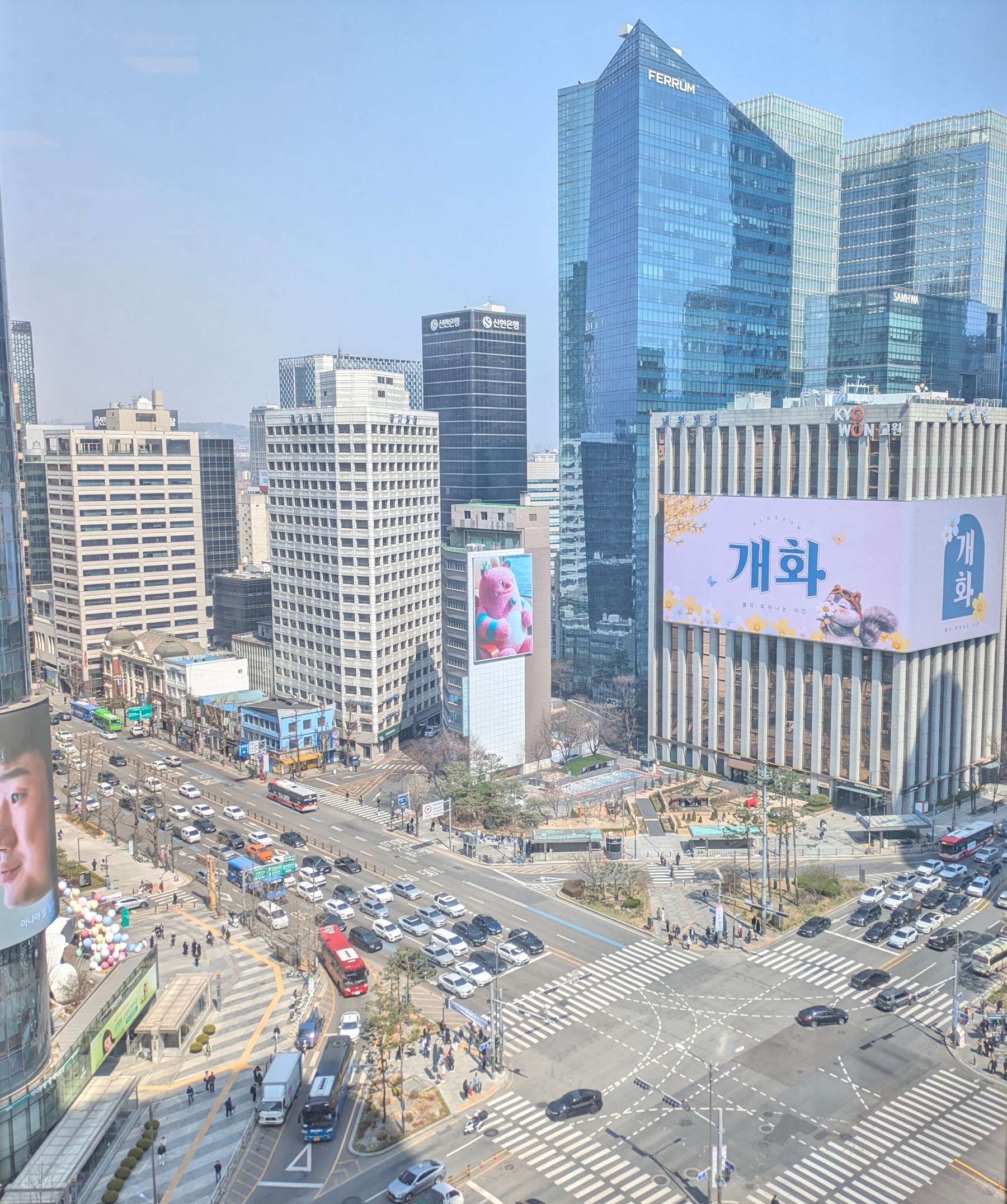
Photograph: Benjamin Jeary · Seoul
Reviewed 22 October 2026 · New online guide. General planning guidance; source types and verification limits are stated below. Not included in the original 2027 print edition; included in the complete Digital Guidebook.
- Primarily for D-2 degree students; D-4 conditions differ.
- Check your permitted stay date before your programme ends.
- Confirm permission before beginning any job or internship.
Check eligibility before planning a D-10 stay.
The three-year maximum concerns eligible Korean-university graduates — not everyone finishing a course. These checks prepare your questions; they do not determine your eligibility.
- Your qualification: Confirm that your Korean degree and completion evidence meet the graduate-route requirements. D-4 language training alone is not the same as graduating from a Korean university.
- Your current status and history: Check your permitted stay date, whether you can change status, and how any previous D-10 periods affect your application.
- Your proposed activity: Confirm that your professional job search or internship fits D-10 conditions; ordinary casual work is not automatically permitted.
- Your evidence: Ask which academic, financial, residence and job-seeking documents are required, and whether any exemptions apply to you.
- Your approval: Ask immigration whether the newer graduate arrangements apply, what period may be granted and what is needed for each extension. Three years is not guaranteed or granted automatically.
Start here: graduation is not a visa category
You can be academically finished with a course and still have immigration paperwork to complete. Your degree, your university enrolment and your permitted period of stay are related, but they are not identical.
The first thing to check is the permitted stay date shown in your immigration record. Do not assume that graduation automatically extends it, that a university can extend it for you or that a job application gives you permission to remain in Korea. If your plans require a different status, ask about the procedure before your present permission expires. [4]
This guide gives you a practical framework, not a personal eligibility decision. Rules differ by nationality, degree, immigration history, job type and other factors. For the final answer, use HiKorea, the Korea Visa Portal, your university's international office and the immigration contact centre at 1345.
1. Choose your likely pathway
Most international degree graduates considering their next step fall into one of these situations.
Route A. You have an eligible professional job offer
If you meet the requirements for a work-related stay status, you may be able to apply to change directly from D-2 to the relevant employment category, rather than using D-10 first. The government's Study in Korea guidance identifies professional categories including E-1 (professor), E-3 (research), E-4 (technical guidance), E-5 (professional employment) and E-7 (specific activities), along with other qualifying categories. You must have the right job, qualifications, employer documentation and employment contract. [4]
Important: An offer letter alone does not authorize you to start full-time work. Confirm that the necessary change or permission has been granted and when you may lawfully begin.
Route B. You want time to search for eligible work
D-10-1 is Korea's job-seeking route for qualifying applicants seeking professional employment or undertaking permitted job-seeking activities and internships. Eligible students who have completed or are approaching completion of a Korean associate degree or higher may be able to apply. It is not a general open work permit and does not cover unrestricted casual work. [4]
The Ministry of Justice announced expanded arrangements for eligible graduates from Korean universities in December 2025: a maximum of three years, with extensions of up to one year at a time, replacing the previously stated maximum of two years and six-month extensions. It also removed the overall internship-duration cap for the relevant group while increasing the permitted period with a single company to one year. The change does not mean that every applicant receives three years at once, or that any internship is permitted without checking its conditions. [3]
Check carefully: Some government information pages still describe the previous two-year/six-month rules. Confirm which rule applies to your exact application and whether any conditions or subsequent changes affect you before using the longer period in a financial or career plan. [3][4]
Route C. You are leaving Korea, continuing study or considering another status
You may decide to return home, study for another qualification, move abroad or explore a different residence category for which you independently qualify. These are different paths with different documentary and timing requirements. Do not treat D-10 as mandatory for every graduate, or assume that changing universities or enrolling on another course automatically solves immigration deadlines.
A note for D-4 students: Language-training status is not the same as D-2 degree-study status. The D-2 graduate pathways described here should not be assumed to apply to D-4 trainees. Ask immigration or your institution which change-of-status possibilities are open to you.
2. Work backwards from your permission-to-stay date
Use this suggested planning schedule, adjusting it to your own academic calendar. These are organisational milestones, not statutory deadlines.
Six months before the expected finish: Identify likely occupations and the qualifications employers request. Review your Korean-language goals, finances and portfolio. Speak to your international office if you may need a status change.
Three months before: Prepare a Korean-style or international CV as appropriate, a short professional introduction, project examples and referee details. Ask your academic office when a completion letter, transcript or graduation certificate can be issued.
Six to eight weeks before: Check the immigration booking system and document requirements. Ask whether your prospective status change can be filed before graduation on the basis of expected completion; eligibility may differ by route. Gather the documents that are difficult to obtain quickly.
Before your current stay expires: Submit the appropriate, complete application in the permitted manner and timeframe. Keep evidence of submission. Merely booking a future appointment should not be treated as proof that your status was extended or changed.
After a decision: Keep your approval and updated immigration details, confirm when employment or internship activities are allowed and record any future extension or reporting dates.
3. D-10: what it permits and what it does not
D-10 is intended for job-seeking in qualifying professional fields and certain permitted internships or preparation activities. It should not be confused with student part-time work permission or a general right to work in restaurants, cafés, delivery services or any other job you can find. The government's Study in Korea guidance explicitly distinguishes D-10 job-seeking activity from unskilled or manual work. [4]
If a company offers you an internship, check three things before accepting: whether the proposed activity falls within your approved D-10 conditions; whether any employer-specific or activity-specific filing or permission is needed; and what duration limits apply to you. Do not assume that an internship described as 'training' is automatically exempt from immigration rules.
If you receive a suitable full-time offer, you usually need to move into the appropriate employment status before taking up employment. Ask both the employer and immigration which documents are required and who will prepare them. [4]
4. Prepare a document folder for immigration
The exact list depends on your status, application type and caseworker instructions. The following is a preparation checklist, not a definitive list that guarantees acceptance.
- Identity and current status: passport, current residence card where applicable, up-to-date contact information and application form.
- Academic evidence: graduation certificate or expected-graduation letter, transcript, and any additional educational documents requested.
- Purpose of stay: a realistic job-seeking activity plan for D-10, or the proposed employer's role and contract documents for work status.
- Residence evidence: lease, accommodation confirmation or other accepted proof showing where you live.
- Qualifications: language scores, career certificates, licences, professional portfolio or other evidence where relevant.
- Financial evidence: bank statements or proof of living expenses when required; check possible exemptions rather than assuming they apply.
- Application logistics: current fee, appointment or electronic-filing route, copies of submitted documents and confirmation of receipt.
The government Study in Korea guidance lists a job-seeking plan, academic proof and a range of standard documents for D-2-to-D-10 applicants, while noting that some documents may be waived or adjusted. It also describes a financial-proof exemption for some first-time D-2-to-D-10 changes, but because the page contains older D-10 duration information, verify the current financial evidence rule before applying. [4]
5. Finding work: begin with the visa-eligible role
Searching only for 'English-speaking jobs' often creates a misleading shortlist. Some jobs are perfectly real but do not provide a suitable basis for the applicant's intended immigration status. Others may require qualifications, Korean ability or employer documents that are not obvious in the advert.
A stronger approach is to work in this order:
- Occupation: What will you actually do, and which employment status might cover it?
- Your qualifications: Does your degree, experience or licence meet the category requirements?
- Employer: Is the business identifiable, and can it provide the necessary documentation?
- Working conditions: Are the duties, workplace, salary, hours and contract terms clear?
- Timing: Can a lawful change of status be completed before the intended start date?
Government guidance indicates that for qualifying bachelor's-degree graduates the job need not necessarily match their academic major, but the professional occupation and all other immigration requirements must still qualify. Do not read this as a promise that any degree leads to any E-7 job. [4]
Use your university's career office, professors, alumni, professional associations and official or established recruitment platforms. Study in Korea lists government-linked resources and platforms for foreign applicants. [5] Settle Seoul's Other English-speaking Jobs board can also help you discover possibilities, but inclusion in a job listing never establishes your visa eligibility or guarantees employer sponsorship.
6. CVs, interviews and Korean language
Your CV should help an employer assess your capabilities quickly. Start with a clear job title and a short summary. Include relevant degree details, projects, practical experience, tools, languages and achievements. If you have an online portfolio, make it easy to open.
For applications in Korea, some employers request a Korean-style resume and 자기소개서 (personal statement), while others accept an international English-language CV. Follow the employer's actual instructions rather than assuming a single template is universal. Do not include personal information that is unnecessary or that an employer has no legitimate reason to request.
During an interview, be ready to explain your current residence status accurately, whether you require an employer-supported change of status, and the earliest date you could legally begin work. You do not need to provide speculative legal assurances. It is reasonable to tell an employer that eligibility must be confirmed through the official process.
Korean proficiency may expand opportunities and help you navigate workplaces, but there is no one language score that guarantees a job or a visa in every category. Check the requirements of the occupation and employer, and consider practical workplace Korean alongside test preparation.
7. How to examine an offer before signing
A promising offer is the beginning of due diligence, not the end of it. Before accepting, obtain the proposed contract and check:
- The legal employer name and business details, job title and specific duties.
- Work location, working hours, rest time, salary, pay date and any deductions.
- The length of the contract, probation arrangements and how termination works.
- Benefits and insurance arrangements that may apply to your employment.
- Whether the employer understands and can support the immigration process for the particular job.
- Whether the proposed start date gives enough time for legal permission to be resolved.
Keep the original advert and the final signed documents. Be cautious if an intermediary demands a substantial advance 'visa sponsorship' payment, avoids identifying the employer or pressures you to begin work before approval. If a proposal sounds inconsistent with your permission to stay, ask immigration or a qualified adviser before acting.
8. What about part-time work, freelancing and remote clients?
While studying, permitted part-time work under D-2 or some D-4 statuses generally requires prior authorisation; conditions vary by programme, Korean-language proficiency, academic record and other factors. Some activities, including private tutoring, have special restrictions. [4]
After finishing studies or moving to D-10, do not assume that your former student part-time authorisation continues, that D-10 permits ordinary casual work or that remote work for overseas clients is automatically exempt from Korean immigration and tax rules. The location of the client is not the only relevant issue. Confirm the proposed activity before accepting payment.
The safest question is specific: 'I hold [status] and have been offered [duties] by [employer/client], at [location], for [hours/pay]. Is that permitted, and is any prior permission required?' Record the answer and the date.
9. Keep everyday life working during the transition
Housing. You may lose access to university accommodation after finishing your programme. Check your move-out date, deposit return terms and any documents you will need as proof of your new address. Registered foreign residents generally have 15 days to report an address change; check the procedure and accepted documents with HiKorea. [4]
Money. Plan for a job search that may take longer than expected. Budget for accommodation, food, transport, immigration fees and an emergency buffer. If evidence of funds is required for your application, verify the current rule and the form of proof accepted.
Phone and banking. Keep access to a working Korean number and essential account records while your identity and residence details are updated. If mobile verification stops working after a status change, check whether the carrier and other services hold your name and residence details consistently.
Healthcare. Review your National Health Insurance status or other appropriate coverage as your student or employment circumstances change. Do not assume that a university arrangement or student exemption continues indefinitely.
Travel. If you plan to leave and re-enter Korea while a status change or new residence card is being processed, obtain case-specific advice first. Do not assume a pending application gives unrestricted travel rights.
10. Frequently asked questions
Can I stay in Korea just because I graduated here? Not automatically. Your permission to remain is tied to an approved stay status and period. Check your current expiry date and apply for any necessary change or extension through the proper process. [4]
Does the new D-10 rule give everyone three years? No. The Ministry of Justice described a maximum period of up to three years for a relevant group of Korean-university graduates, with one-year extensions. Individual eligibility, documents, extension decisions and other conditions still apply. [3]
Can I work in a café while on D-10? Do not assume so. D-10 is a professional job-seeking route, not an unrestricted permission for ordinary casual employment. Ask immigration about the exact duties and status before starting. [4]
Can I change directly from D-2 to E-7? Possibly, if you meet the relevant requirements and have a qualifying job and employer. D-10 is not a compulsory intermediate step in every case. [4]
What if I studied Korean on D-4 rather than completed a degree on D-2? Your possible change-of-status routes can be different. The graduate rules in this guide are aimed primarily at D-2 degree students. Seek advice specific to your D-4 subcategory.
What if the job offer is in a field different from my major? The degree-major relationship is only one part of the assessment. Some graduates may have flexibility, but the occupation, qualifications, employer and status criteria still matter. [4]
Can I work for overseas clients while living in Korea? Do not assume that overseas payment or remote delivery removes immigration or tax obligations. Get individual advice based on your status and the work.
Should I use an immigration agent? You can use university and official guidance directly. For complicated cases, consider a properly qualified professional, but verify credentials and never surrender original documents without understanding why.
11. Your next-action checklist
Before the end of your programme, aim to be able to say:
- I know my current permitted stay date and where to verify it.
- I have asked my university which documents it can issue and when.
- I understand whether I am aiming for D-10, a qualifying work status or another route.
- I have checked whether a job or internship requires permission before I start.
- I have a CV, evidence of skills and an organised application record.
- I know where I will live and how to document that address.
- I have checked my budget and health coverage for the transition.
- I have saved the current official immigration guidance and know how to reach 1345.
Useful official starting points: HiKorea · Korea Visa Portal · Study in Korea — employment system · Study in Korea — residence and stay · Study in Korea — finding employment
Related Settle Seoul reading: Study in Seoul · Studying in Seoul · Part-time Work for Students · Jobs · Banking · Housing
Editorial and legal disclaimer: General information as at 22 October 2026. Immigration criteria, forms, processing practices and employment rules can change and may be different for each applicant. Verify your eligibility and permitted activities with the competent immigration authority before making decisions. This guide is not an official government publication or legal advice.
Source notes for Guide B: [3] Ministry of Justice D-10 update; [4] government Study in Korea immigration and employment guidance; [5] government Study in Korea recruitment guidance. Full URLs appear in Sources & verification below.
Editorial guide based on official sources, reviewed 22 October 2026. Confirm current requirements with the responsible office before acting.