

The Complete E-2 Teaching Visa Guide: Arrival, Your First Year & Renewal.
From accepting the offer through the second teaching year — what teachers and schools must do and what changes after your contract
Illustrative · school induction, not an identified institution.
Reviewed 17 October 2026 · New online guide. General planning guidance; source types and verification limits are stated below. Not included in the original 2027 print edition; included in the complete Digital Guidebook.
- Your contract and immigration-authorised stay have separate expiry dates.
- E-2 workplace changes generally use a 15-day report — not E-9 prior permission.
- Plan renewal, transfer or departure before the sponsored job ends.
What E-2 authorises — and what it does not
E-2 is a foreign-language teaching status, not general permission to work in Korea. The school, teaching activity and authorised place of work matter. An offer, visa issuance and residence permission are separate stages.
Eligibility comes before travel
- For the usual native-language teacher route, immigration checks nationality, native-language qualifications, an eligible university degree and the sponsoring institution. For English, the standard route commonly covers citizens of Australia, Canada, Ireland, New Zealand, South Africa, the UK and the US; nationality alone does not establish eligibility.
- Education history, a degree from a different country, dual nationality and special programme routes can change the document assessment. Confirm your exact E-2 category through the Visa Portal, consulate and 1345 rather than assuming a recruiter’s approval is final.
- Teach only the authorised foreign-language activity at eligible institutions and declared or authorised workplaces. Private tutoring, extra teaching at another academy or unrelated paid work is not automatically permitted; confirm the separate process before accepting it.
Two dates, two different meanings
- The employment contract fixes employment dates and agreed terms. Immigration sets the allowed period of stay. A signed twelve-month contract does not extend a residence card or grant workplace permission.
- Record contract start/end, passport expiry and allowed-stay expiry separately. The residence card is evidence of status, not a promise that employment can end without immigration consequences.
| Route | Who hires / places you | What to confirm |
|---|---|---|
| Private academy (hagwon / 학원) | An individual academy or its employing business | Exact legal employer, registered teaching site, working hours, housing and immigration sponsorship documents. A recruiter is not necessarily your employer. |
| Public school via EPIK | EPIK recruits; an education office employs/places teachers under its programme contract | Spring 2027 programme requirements, placement and orientation instructions, co-teaching arrangements and the issuing education office. Do not copy a hagwon checklist blindly. |
- Private academy (hagwon / 학원)
- Who hires / places you: An individual academy or its employing business
- What to confirm: Exact legal employer, registered teaching site, working hours, housing and immigration sponsorship documents. A recruiter is not necessarily your employer.
- Public school via EPIK
- Who hires / places you: EPIK recruits; an education office employs/places teachers under its programme contract
- What to confirm: Spring 2027 programme requirements, placement and orientation instructions, co-teaching arrangements and the issuing education office. Do not copy a hagwon checklist blindly.
Evaluate the offer, then negotiate in writing
Compare the whole working week and the whole cost of living, not just the headline salary. Ask for the complete contract and resolve unclear terms before you resign, book travel or hand over original documents.
Pay, hours and the classroom
- Ask whether the salary is gross or net, the pay date, the hourly/overtime calculation and every proposed deduction. Request an example itemised payslip; do not confuse pension, insurance and tax with a recruiter’s “take-home” estimate.
- Write down teaching periods per week and the length of each period, total on-site hours, break time, paid planning, meetings, camps, weekend events and any split shifts. “30 classes” is not necessarily 30 clock hours.
- Ask who supplies books and curriculum, whether lesson preparation is inside paid working time, which ages and class sizes you will teach, and whether observation or demonstration lessons are expected.
Leave, housing and benefits
- Confirm how annual leave is scheduled, how national holidays and school closures are handled, and which labour protections apply to the actual workplace. Employer size, service length and employment arrangements can affect entitlements; a printed clause is not proof it is lawful.
- For employer housing, record the address or standard, furnishings, utilities, maintenance charges, deposit, deductions, repairs and move-out obligations. Ask what happens if housing is unsuitable or the job ends early.
- Confirm health-insurance enrolment, pension coverage and nationality/treaty eligibility, employer contributions, airfare payment or reimbursement, settlement allowances and early-exit terms. Do not assume every nationality receives a pension refund.
- Ask about probation, termination notice, repayment clauses and transfer cooperation. Automatic penalties or deductions can be unlawful; take questionable clauses to 1350 or a qualified adviser instead of accepting them as standard.
The new-applicant document file
This is a preparation matrix, not a universal consulate checklist. Get the current list from the sponsoring school and the Korean mission handling your nationality and residence. Ask who keeps each original and retain scans and courier records.

Authentication and timing
- Begin national criminal-record and degree authentication early. Apostille/legalisation routes, accepted issuers, document validity periods and translations vary. Do not substitute a local police check for a required national check without confirmation.
- The employer typically supplies institutional documents for issuance confirmation; the teacher then follows the consulate’s visa application process. Issuance confirmation is not itself permission to enter and teach.
- Keep names and dates consistent across passport, degree, criminal check, contract and forms. Confirm whether originals, authenticated copies or certified immigration-held copies are accepted at each stage.
EPIK Spring 2027 is a programme checklist
- EPIK’s required-document guidance is updated for Spring 2027 (July 2026). It adds programme materials such as sealed transcripts, two recommendation letters, the programme application and qualification evidence. These are not all universal E-2 requirements.
- EPIK generally requires a 100-hour-or-more TEFL/TESOL/CELTA certificate where the qualifying education-degree/teaching-licence exemption does not apply. Placement-specific practicum requirements may differ; check EPIK’s current qualification guidance.
- UK and Australian applicants must check EPIK’s birth-certificate and related country-specific instructions. Do not tell all E-2 applicants from every country to obtain a birth certificate.
- In-country EPIK applicants should check the used-document rules. Eligible prior E-2 degree/criminal-check records may be replaced by certified copies from the original-holding authority; hagwon immigration copies need the itemised receipt. EPIK also asks for an Entry & Departure Certificate covering records from birth, both sides of the valid residence card and the initial Visa Grant Notice if still available. An absence over 90 consecutive days since the prior document submission invalidates this reuse route. Other required programme records still apply.
| Document | Teacher | School / programme | When / verify |
|---|---|---|---|
| Passport and photos | Valid passport; recent photos to specified size | Check identity matches contract | Before application; passport validity, size and photo count with consulate/HiKorea |
| Degree | Degree and accepted apostille/legalisation or authenticated copy | Confirm eligibility and submission route | Start early; issuer, country and copy/original rules |
| National criminal-background check | Obtain required national check and authentication | Confirm acceptable document | Before issuance; freshness and nationality-specific requirements |
| Signed employment agreement | Read and keep a signed complete copy | Supply signed contract identifying employer/site | Before issuance; duties, term and employer match |
| Visa application / issuance confirmation | Complete consulate form; submit fee and required originals | Provide confirmation/application support as applicable | Before travel; mission jurisdiction, procedure and confirmation validity |
| Institution documents | Keep the sponsor’s contact and legal name | Academy registration/licence, business registration and other required school documents | Employer’s issuance stage; exact E-2 institution requirements |
| Medical / health check | Complete self-health statement and required examination at accepted provider | Explain programme and immigration examination arrangements | As instructed, often after arrival for registration; health forms/provider/expiry differ |
| EPIK extras — programme only | Sealed transcripts, references, qualification evidence and country-specific records | EPIK / education office specifies pack | Spring 2027 current instructions; used-document rules for in-country applicants |
- Passport and photos
- Teacher: Valid passport; recent photos to specified size
- School / programme: Check identity matches contract
- When / verify: Before application; passport validity, size and photo count with consulate/HiKorea
- Degree
- Teacher: Degree and accepted apostille/legalisation or authenticated copy
- School / programme: Confirm eligibility and submission route
- When / verify: Start early; issuer, country and copy/original rules
- National criminal-background check
- Teacher: Obtain required national check and authentication
- School / programme: Confirm acceptable document
- When / verify: Before issuance; freshness and nationality-specific requirements
- Signed employment agreement
- Teacher: Read and keep a signed complete copy
- School / programme: Supply signed contract identifying employer/site
- When / verify: Before issuance; duties, term and employer match
- Visa application / issuance confirmation
- Teacher: Complete consulate form; submit fee and required originals
- School / programme: Provide confirmation/application support as applicable
- When / verify: Before travel; mission jurisdiction, procedure and confirmation validity
- Institution documents
- Teacher: Keep the sponsor’s contact and legal name
- School / programme: Academy registration/licence, business registration and other required school documents
- When / verify: Employer’s issuance stage; exact E-2 institution requirements
- Medical / health check
- Teacher: Complete self-health statement and required examination at accepted provider
- School / programme: Explain programme and immigration examination arrangements
- When / verify: As instructed, often after arrival for registration; health forms/provider/expiry differ
- EPIK extras — programme only
- Teacher: Sealed transcripts, references, qualification evidence and country-specific records
- School / programme: EPIK / education office specifies pack
- When / verify: Spring 2027 current instructions; used-document rules for in-country applicants
Sources · reviewed 17 October 2026
From the airport to your first school day
The following is a recommended induction agenda. Good onboarding is not the same thing as a statutory entitlement; confirm contractual support and programme instructions separately.
Travel and employer housing
- Before flying, confirm the entry visa, address in Hangul, emergency contact, airport meeting point, transfer cost and what happens after a delayed flight. EPIK arrivals must follow the programme’s orientation and transfer instructions.
- Photograph accommodation condition, furniture, meter readings and any damage before unpacking. Test locks, heating, hot water and smoke alarms; ask who pays utilities and reports repairs. Keep an accepted proof-of-residence route ready.
- Carry a temporary phone connection and enough accessible money for transport, food and the period before payday. Never pack the only copies of essential documents in checked baggage.
A practical first-day agenda
- Meet the director, co-teacher, administrator and emergency/safeguarding lead. Get a named contact for timetable, payroll, immigration, housing and classroom concerns.
- Walk through curriculum, books, lesson aims, assessment, class ages and sizes, teaching periods and breaks. Confirm the planning timetable, printing, classroom technology and access to materials.
- Observe an agreed class; clarify whether the Korean co-teacher manages translation, behaviour, attendance or parent communication. Do not assume one person handles everything.
- Ask for attendance and absence procedures, authorised child handoff, dismissal/bus routines, safeguarding escalation, medical emergencies and rules for photos or messaging children. Clarify who communicates with parents and through which approved channel.
- Agree the first week’s lesson expectations, feedback meeting and where to record hours. Raise a mismatch between the offer and reality promptly in writing.
Sources · reviewed 17 October 2026
Registration, address and everyday systems
For a stay above 90 days, foreign registration generally must be completed within 90 days of entry. Make the appointment early; a reservation alone is not a completed filing. Special entry/status cases can have different timing.
Prepare the registration visit
- Use HiKorea to check the responsible office, reserve if required, and obtain the current E-2 registration list. Typical preparation includes passport, application, photo, accepted accommodation evidence, employer documents, required medical results and the current fee.
- Employer housing may need a confirmation of accommodation plus the provider’s identification and supporting lease or ownership evidence. Ask immigration which combination it accepts, rather than arriving with only a recruiter’s address message.
- The school can organise help or an authorised representative where allowed. The teacher must still verify the filing, receipt, correct address, card details and allowed-stay date. Ask about collection/delivery and keep the application acknowledgement.
After moving or starting payroll
- Registered foreign residents generally report a new place of stay within 15 days of moving. A school’s internal update or a housing lease report does not replace your immigration address report.
- Open a bank account using the branch’s identification and purpose-of-account requirements; arrange payroll timing if the residence card is still pending. Link the phone subscription to the correct legal name when identity verification becomes available.
- Ask payroll for written health-insurance and pension registration details, employee/employer contributions, applicable nationality exclusions and tax withholding. Save payslips; insurance eligibility and pension refunds are separate questions.
- Check the first payment against the contract and actual hours, not just a bank deposit. Resolve missing enrolment or unexplained deductions with the relevant agency and 1350.
School versus teacher: who does what?
The employer provides institutional support; immigration decides status. Neither a director’s promise nor a new employment contract legally extends your stay. Keep acknowledgements for your own filings and the school’s separate reports.

Separate notifications, separate accountability
- The employer generally must report reportable employment changes, including employment ending, within 15 days. The teacher’s E-2 workplace-change report is a separate obligation; one party’s report is not automatically the other’s filing.
- For transfers and extensions, ask exactly who submits which form, on what date and by which authority. Authorised assistance does not remove the need to verify approval or acceptance.
- Contractual housing, leave and duties must be assessed alongside applicable labour law. Immigration acceptance of a contract is not a ruling that every clause is lawful.
| Task | School / education office | Teacher |
|---|---|---|
| Initial immigration documents | Provide eligible institution/business documents and signed contract; support lawful sponsorship | Supply personal records, follow consulate route and verify entry/work status |
| Registration / renewal | Provide current employer documents; assist where authorised | Check deadline, make/verify actual filing and retain result; only immigration grants extension |
| End / workplace change | File its own reportable employment-end/change notification generally within 15 days | File required E-2 workplace-change report generally within 15 days; confirm early-end case and stay |
| Pay / statutory deductions | Pay agreed lawful wages; itemise authorised deductions and remit applicable contributions | Keep payslips, hours and bank receipts; query errors and check coverage |
| Paid leave / accommodation | Meet applicable law and agreed contract; explain leave scheduling and housing obligations | Request/record leave, protect property and keep housing inspection and deposit evidence |
| Tax / certificates | Withhold/remit as required; provide payroll/tax and employment records | Check tax treatment, retain certificates and complete personal obligations where required |
| Safeguarding / teaching duties | Set lawful policies, training, supervision and approved communication | Follow authorised duties and safeguarding procedures; report concerns promptly |
| Contract evidence | Provide signed copies and written changes | Keep independent copies; never rely only on a verbal assurance |
- Initial immigration documents
- School / education office: Provide eligible institution/business documents and signed contract; support lawful sponsorship
- Teacher: Supply personal records, follow consulate route and verify entry/work status
- Registration / renewal
- School / education office: Provide current employer documents; assist where authorised
- Teacher: Check deadline, make/verify actual filing and retain result; only immigration grants extension
- End / workplace change
- School / education office: File its own reportable employment-end/change notification generally within 15 days
- Teacher: File required E-2 workplace-change report generally within 15 days; confirm early-end case and stay
- Pay / statutory deductions
- School / education office: Pay agreed lawful wages; itemise authorised deductions and remit applicable contributions
- Teacher: Keep payslips, hours and bank receipts; query errors and check coverage
- Paid leave / accommodation
- School / education office: Meet applicable law and agreed contract; explain leave scheduling and housing obligations
- Teacher: Request/record leave, protect property and keep housing inspection and deposit evidence
- Tax / certificates
- School / education office: Withhold/remit as required; provide payroll/tax and employment records
- Teacher: Check tax treatment, retain certificates and complete personal obligations where required
- Safeguarding / teaching duties
- School / education office: Set lawful policies, training, supervision and approved communication
- Teacher: Follow authorised duties and safeguarding procedures; report concerns promptly
- Contract evidence
- School / education office: Provide signed copies and written changes
- Teacher: Keep independent copies; never rely only on a verbal assurance
Sources · reviewed 17 October 2026
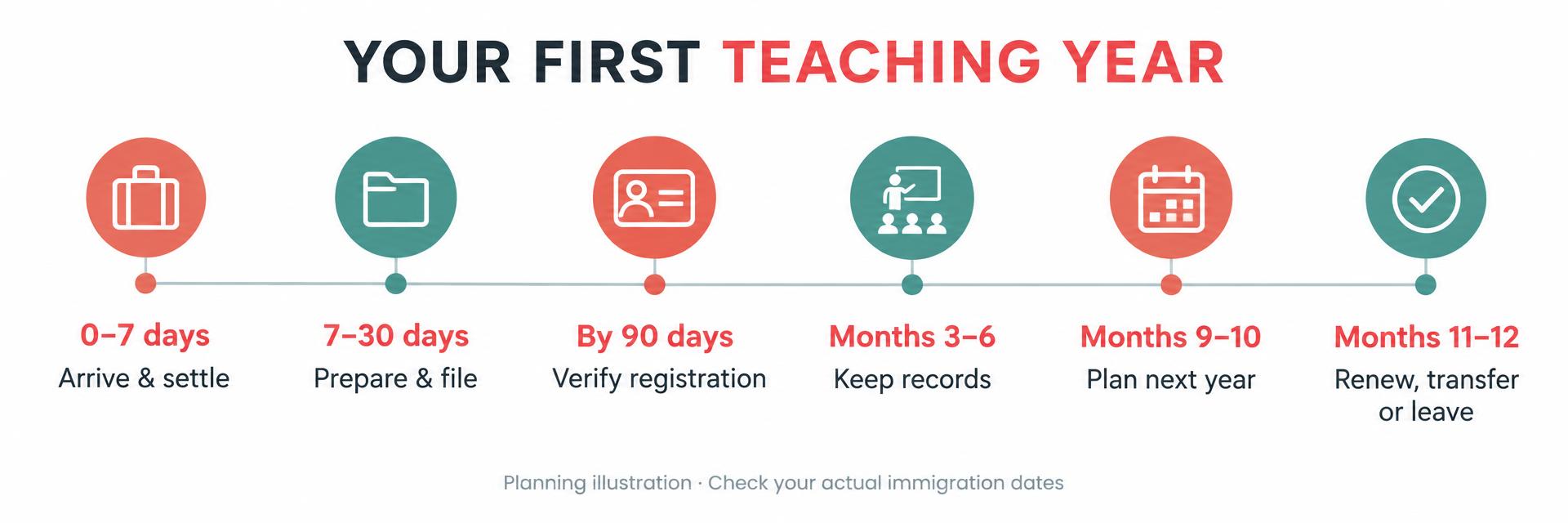
Your first-year timeline
Count from entry and employment start separately. This planner is recommended administration, not a promise of a particular immigration deadline or a twelve-month permission period.
A monthly record habit
- Save the signed contract and amendments, timetable and actual hours, payslip, salary receipt, leave requests/approvals, insurance/pension records and important employer messages each month.
- Keep passport and residence-card expiry, address and registered workplace in the front of your folder. Back up scans securely and never put sensitive records into public community posts.
- At months 9–10, discuss the next contract and check the real allowed-stay date. Do not wait for the final teaching day to discover that the immigration deadline came earlier.
| When | Actions | Record |
|---|---|---|
| Days 0–7 | Confirm safe housing, transfer, school induction, timetable and medical/registration route | Housing photos, signed contract, contact sheet and visa/entry record |
| Days 7–30 | Complete required health check; prepare/file registration as instructed; arrange phone, bank and payroll | Appointment/filing receipts, medical result, proof of housing |
| By day 90 | For stays over 90 days, verify registration completed within applicable 90-day entry deadline | Residence-card details, filing evidence and authorised-stay expiry |
| Months 3–6 | Review teaching workload, deductions, coverage and leave; report any address change promptly | Monthly payslips, hours, contributions and leave records |
| Months 9–10 | Choose next-year path; check extension window, new employer eligibility or gap/departure plan | Written offer/contract and immigration questions |
| Months 11–12 | File extension/transfer steps when required; agree final-pay and housing handover plan | Filing results, exit/transfer evidence, pay and handover checklist |
- Days 0–7
- Actions: Confirm safe housing, transfer, school induction, timetable and medical/registration route
- Record: Housing photos, signed contract, contact sheet and visa/entry record
- Days 7–30
- Actions: Complete required health check; prepare/file registration as instructed; arrange phone, bank and payroll
- Record: Appointment/filing receipts, medical result, proof of housing
- By day 90
- Actions: For stays over 90 days, verify registration completed within applicable 90-day entry deadline
- Record: Residence-card details, filing evidence and authorised-stay expiry
- Months 3–6
- Actions: Review teaching workload, deductions, coverage and leave; report any address change promptly
- Record: Monthly payslips, hours, contributions and leave records
- Months 9–10
- Actions: Choose next-year path; check extension window, new employer eligibility or gap/departure plan
- Record: Written offer/contract and immigration questions
- Months 11–12
- Actions: File extension/transfer steps when required; agree final-pay and housing handover plan
- Record: Filing results, exit/transfer evidence, pay and handover checklist
Sources · reviewed 17 October 2026
What happens after year one?
Choose the situation that matches your next step. These are preparation paths, not an eligibility decision. A contract renewal, an employment dispute and permission to stay are different processes.

New contract + E-2 stay extension
Signing again does not automatically extend immigration permission. Apply before your authorised stay expires.
Compare all four paths
A · Renew at the same school
Signing again does not automatically extend immigration permission. Apply before your authorised stay expires.
B · Move to another eligible E-2 school
E-2 generally uses a report within 15 days of the workplace change, not the E-9 prior-permission procedure. Confirm the facts before starting.
C · Finish with no new employer
There is no blanket 30-day grace period. Do not rely on the residence-card expiry alone once the sponsored job ends.
D · Closure, early dismissal or dispute
An employment claim does not automatically extend a visa or permit work elsewhere. Seek immigration and labour advice urgently.
B · Move to another eligible E-2 school · Workplace-change report — and possibly extension
E-2 generally uses a report within 15 days of the workplace change, not the E-9 prior-permission procedure. Confirm the facts before starting.
- ☐ Confirm the new institution and teaching activity are eligible for your E-2, and agree a signed contract and genuine start/change date. Do not confuse a new contract with automatic immigration compliance.
- ☐ Prepare the workplace-change report, passport, residence card, new contract and required new-school documents; confirm exact documents, filing channel and timing with immigration. The general E-2 report deadline is 15 days after the change.
- ☐ EasyLaw’s Manual summary says an extension is also needed if the new contract period plus one month exceeds the remaining authorised stay. Ask immigration to calculate the relevant dates in your case.
- ☐ The previous employer has its own employment-end notification. Keep completion/termination evidence and ask whether a letter of release or another explanation is needed for your particular early-exit transfer. A letter of release is not universally required in every completed-contract transfer.
- ☐ A fresh overseas E-2 application is not automatically mandatory for every in-country transfer. Confirm accepted previously submitted documents, including criminal checks, with immigration and EPIK where relevant.
C · Finish with no new employer · Resolve the gap before employment ends
There is no blanket 30-day grace period. Do not rely on the residence-card expiry alone once the sponsored job ends.
- ☐ Call 1345 before your last employment day. Give contract-end date, allowed-stay expiry, nationality, current status and intended departure or job-search plan.
- ☐ Ask whether you qualify for D-10 or another status, whether an application is permitted in-country, the deadline and the effect of the employer’s end report. A job-search intention is not authorisation.
- ☐ If a change of status is available, prepare and file through the required process and wait for the applicable permission. Do not teach during a gap or while merely intending to apply.
- ☐ If leaving Korea, confirm the lawful departure date, residence-card return requirements, insurance/pension closure and housing handover. Obtain final wage/tax records before losing access.
- ☐ Keep written confirmation and filing/departure evidence. Neither a recruiter’s promise nor an unused date on a card guarantees lawful stay after a status-changing event.
D · Closure, early dismissal or dispute · Protect evidence and immigration status in parallel
An employment claim does not automatically extend a visa or permit work elsewhere. Seek immigration and labour advice urgently.
- ☐ Save your signed contract, termination/closure notice, timetables, messages, payslips and bank records. Write a dated factual account; keep copies outside school systems.
- ☐ Call 1345 promptly with the dismissal/closure date and ask about reporting, lawful stay, transfer documents, D-10 possibilities and any departure/status-change deadline.
- ☐ Call Labour 1350 about unpaid wages, deductions, termination and complaint routes. Remedies, coverage and filing deadlines depend on the facts; consider an adviser for contested dismissal.
- ☐ Do not assume a letter of release is always possible or universally indispensable. Ask immigration what alternative evidence it accepts for closure, dismissal or employer non-cooperation.
- ☐ Confirm housing access and document safety. Do not start teaching elsewhere until your E-2 workplace/status position is confirmed; keep labour and immigration receipts separately.
Sources · reviewed 17 October 2026
- EasyLaw · E-2 foreign language teachers
- EasyLaw · workplace-change response, 31 March 2026
- EasyLaw · extension of period of stay
- HiKorea · reservations, applications and immigration manuals
- MOEL 1350 · retirement benefits, 2026 guidance
- HiKorea · four-month stay-extension window
- Immigration Act · Article 19 employer reports
Contract completion: money, documents and keys
Begin the handover before your final week. Statutory entitlements depend on actual service, hours, employment coverage and termination facts — they are not simply benefits a director can waive in a contract.
Final money and earned benefits
- Check final salary, authorised deductions, overtime and earned but unused leave where payable under the applicable law. Ask for an itemised calculation rather than a single final bank transfer.
- Statutory severance generally requires at least one year of continuous service and an average of at least 15 scheduled working hours per week over four weeks. The minimum is 30 days of average wage for each eligible year of continuous service.
- Severance is due upon actual termination, not automatically at each annual contract signing. Continuous renewal at the same employer usually calls for continuity to be examined; obtain advice on any proposed “annual settlement”.
- Final wages and retirement benefits generally must be paid within 14 days of termination, subject to lawful arrangements for extending payment in the relevant circumstances. Ask 1350 about a missed payment or disputed calculation.
Close records, not just the classroom
- Confirm health-insurance and pension changes. Pension lump-sum refunds depend on nationality, reciprocal arrangements and individual circumstances; get the NPS answer for your case before departure.
- Request employment/service certificates, references, tax-withholding/year-end records and copies of relevant immigration submissions. Confirm a contact for later payroll or tax questions.
- Agree a housing inspection, deposit reconciliation, utility readings, cleaning obligations, key return and move-out date in writing. Keep dated photographs and receipts; do not authorise unexplained deductions.
- Align last working day, last housing day, next workplace/status filing and lawful departure date. None of those dates automatically equals another.
Sources · reviewed 17 October 2026
- MOEL 1350 · retirement benefits, 2026 guidance
- National Pension Service · international coverage and refunds
- National Health Insurance Service · foreign residents
- National Tax Service · English guidance
- HiKorea · reservations, applications and immigration manuals
- MOEL · final wages and the 14-day rule
- MOEL · severance at termination, not annual payout
Problems at school: protect yourself with evidence
Keep disputes factual and dated. Immigration and labour rules run alongside one another; using a complaint procedure is not itself permission to remain in Korea or work at another school.
Documents, deductions and unpaid pay
- If an employer holds your passport, ask for its immediate return and keep evidence of the request. A school is not immigration. Contact 1345 and your embassy/consulate for advice; call police 112 for immediate danger or threats.
- For deductions, request the contractual/legal basis, payslip and calculation in writing. Compare hours, gross pay and deposits. Do not assume a housing or airfare label makes a deduction lawful.
- For unpaid wages, collect the contract, work records, bank statements, payslips and written requests for payment. 1350 can explain the competent labour office and petition process; eligibility and remedies depend on facts.
Dismissal or employer non-cooperation
- Request a written termination notice, reason and effective date. Preserve the original message and evidence of receipt; do not sign a resignation or settlement you do not understand.
- Ask 1350 whether Labour Relations Commission or labour-office routes fit your case and which deadlines apply. Unfair-dismissal remedies can depend on workplace size and other legal conditions.
- Contact 1345 separately and urgently about the end of sponsored employment. A pending labour claim does not automatically suspend an immigration deadline, extend stay or replace a workplace report.
- If you need interpretation or legal help, use a foreign-resident support centre or qualified professional. Avoid public accusations containing pupils’ data or passport details.
The questions teachers ask at renewal
These answers explain what to verify, not a universal legal outcome. Tell immigration your current E-2 subtype, nationality, contract history, termination facts and actual dates.
“Do I always need a letter of release?”
- No universal rule should be inferred for every situation. Completed-contract changes, early resignation, dismissal, closure and disputed endings can require different evidence. Ask immigration whether a letter or accepted alternative is required in your specific transfer.
“Can I stay 30 days after the job ends?”
- Not as a blanket entitlement. Resolve the gap with 1345 before employment ends; card expiry alone is not a safe answer. D-10 requires eligibility and the proper authorised process.
“Must I get a new criminal check or leave Korea?”
- Not automatically for every renewal or transfer. Previous submissions, time outside Korea, changed circumstances and programme requirements matter. Check immigration’s document list and EPIK used-document guidance rather than assuming either a complete waiver or a fresh overseas application.
“Can I travel while my application is pending?”
- Check your pending application, re-entry position, passport and residence expiry with 1345 before booking. Do not assume departure has no effect on processing or that an application receipt guarantees re-entry.
“Can I teach evenings for another school?”
- Not simply because you already have E-2. A second workplace or activity may require reporting/permission under the applicable procedure. Confirm before extra lessons, paid online work or private tutoring.
“Same school, same visa — nothing to file?”
- Wrong: if you need more allowed stay, file an extension before expiry and verify the decision. A new signed contract, school promise or HiKorea reservation does not automatically extend permission.
Korean glossary and your two essential phone calls
Reviewed 17 October 2026. This is independent editorial preparation, not legal advice or a government form. Recheck live guidance, required documents and fees immediately before filing; the responsible authority determines your case.
Immigration · 1345
- Ask about E-2 eligibility, registration, workplace reporting, extensions, early endings and D-10. Have passport nationality, current status, entry date, allowed-stay expiry, contract dates and exact question ready. Request language assistance and record the date and answer.
- Use HiKorea for the current manual, filing route and appointment requirements; use the Korea Visa Portal and your responsible Korean mission for overseas applications.
Labour · 1350
- Ask about wages, deductions, working hours, leave, severance, dismissal and the appropriate complaint office. Bring a factual timeline and your contract/payroll records. Immigration advice must still be obtained separately.
- Use NHIS, NPS and NTS for insurance, nationality-dependent pension and tax treatment respectively. No school, recruiter or this guide can guarantee immigration approval or a particular legal remedy.
| Hangul | Romanisation | Meaning |
|---|---|---|
| 외국인등록 | oegugin deungnok | Foreign registration |
| 체류기간 연장 | cheryu gigan yeonjang | Extension of period of stay |
| 근무처 변경 신고 | geunmucheo byeongyeong singo | Workplace-change report |
| 근로계약서 | geullo gyeyakseo | Employment contract |
| 퇴직금 | toejikgeum | Severance / retirement payment |
| 체류자격 변경 | cheryu jagyeok byeongyeong | Change of status of stay |
| 거소 / 체류지 | geoso / cheryuji | Residence / place of stay |
| 재직증명서 | jaejik jeungmyeongseo | Certificate of employment |
- 외국인등록
- Romanisation: oegugin deungnok
- Meaning: Foreign registration
- 체류기간 연장
- Romanisation: cheryu gigan yeonjang
- Meaning: Extension of period of stay
- 근무처 변경 신고
- Romanisation: geunmucheo byeongyeong singo
- Meaning: Workplace-change report
- 근로계약서
- Romanisation: geullo gyeyakseo
- Meaning: Employment contract
- 퇴직금
- Romanisation: toejikgeum
- Meaning: Severance / retirement payment
- 체류자격 변경
- Romanisation: cheryu jagyeok byeongyeong
- Meaning: Change of status of stay
- 거소 / 체류지
- Romanisation: geoso / cheryuji
- Meaning: Residence / place of stay
- 재직증명서
- Romanisation: jaejik jeungmyeongseo
- Meaning: Certificate of employment
Sources · reviewed 17 October 2026
- HiKorea · reservations, applications and immigration manuals
- Korea Visa Portal · E-2 application and consulate requirements
- EasyLaw · E-2 foreign language teachers
- MOEL 1350 · retirement benefits, 2026 guidance
- National Health Insurance Service · foreign residents
- National Pension Service · international coverage and refunds
- National Tax Service · English guidance
Editorial guide based on official sources, reviewed 17 October 2026. Confirm current requirements with the responsible office before acting.