Know where to start before you feel unwell.
A neighbourhood clinic is often the practical first stop. Larger hospitals are valuable, but they can involve referrals, higher patient costs, and more complex navigation.
- Check health-insurance status and contribution notices.
- Save one nearby clinic, pharmacy, and emergency route.
- Carry a short medication and allergy record.
Understand how you entered the system
Foreign employees at an insured workplace are generally enrolled through employment. Other registered residents may enter as self-employed insured after the applicable residence period.
Employee insured
- The employer normally reports eligibility for covered employees.
- Contributions are linked to salary and shared according to current rules.
- Check the start date and deduction rather than assuming registration is complete.
Self-employed insured
- Many eligible foreign and overseas-Korean residents become mandatorily insured after six months in Korea.
- Status, residence history, household information, and exceptions can affect the result.
- NHIS sends contribution notices and manages changes directly.
What insurance covers
- NHIS benefits include insured diagnosis, tests, treatment, surgery, hospitalisation, and health checks.
- Patients still pay co-payments and non-covered charges.
- The amount varies by service and level of medical institution.
Where to ask
- NHIS operates a Seoul Center for Foreign Residents at Sindorim.
- Bring identity and supporting records to any required consultation.
- Use official NHIS language support for contribution or eligibility disputes.
If your employer says you are enrolled, confirm that the NHIS eligibility date and deductions match the actual employment start.
Choose the right level of care
Starting at the appropriate clinic can save time and money while helping you reach specialist care when it is genuinely needed.
Neighbourhood clinic
- Often the best first stop for common symptoms, prescriptions, and routine care.
- Search by specialty: internal medicine, ENT, dermatology, orthopaedics, paediatrics, or women's health.
- Call ahead if English support is important.
Hospital
- Useful for specialist testing, procedures, or problems beyond a local clinic.
- Large hospitals may require a referral for the most appropriate insured route.
- International clinics can support booking and interpretation but may charge additional fees.
Emergency
- Call 119 for ambulance, fire, or rescue.
- Give the address and immediate danger first.
- Take identification, medication information, and a contact person if possible.
Before treatment
- Ask whether the service is covered by NHIS.
- Request an estimate for non-covered tests, materials, or rooms.
- Keep the itemised receipt and prescription details.
This guide helps you navigate services. A qualified clinician must assess symptoms and treatment decisions.
Your first clinic visit
Prepare a short symptom, medication and allergy record before visiting. Confirm English support and appointment arrangements directly with the clinic.
- 01Prepare
Keep identification, insurance information, symptoms and their duration together.
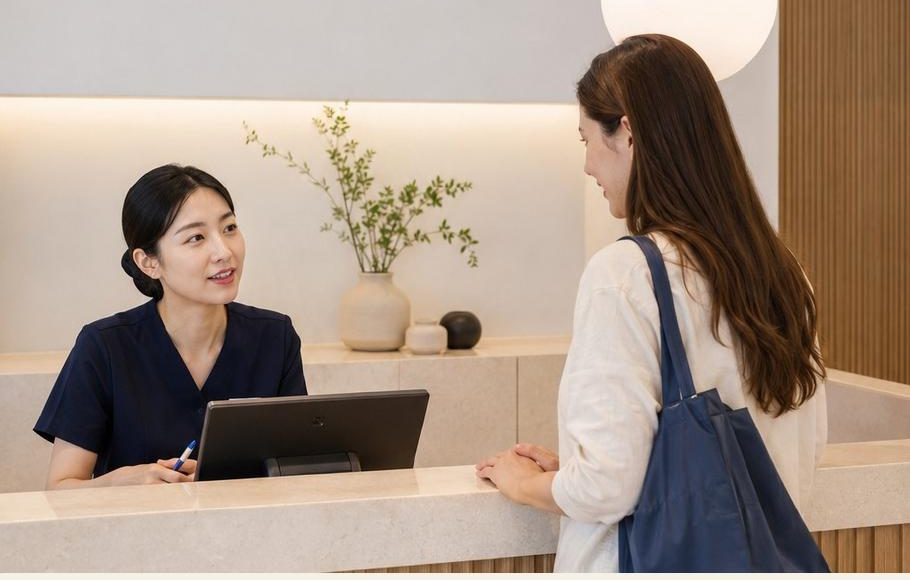
- 02At reception
Explain why you are visiting and ask early whether English support is possible.
- 03During the consultation
Describe symptoms, medicines and allergies clearly. Ask what you should do next and when to return.
- 04Before leaving
Confirm the prescription, payment, itemised receipt and any follow-up instructions.
This guide helps you find and use services. A qualified clinician must assess your symptoms and treatment.
Show this at reception
Fill in the blanks before you leave home, then read the Korean aloud or show it on your phone. Hangul comes first, then romanisation, then English.
Checking in
- 진료 받으러 왔어요 · Jillyo badeureo wasseoyo — I'm here to see a doctor.
- 건강보험 있어요 · Geongang boheom isseoyo — I have health insurance.
- 외국인등록증 / 여권 여기 있어요 · Oegugin deungnokjeung / yeogwon yeogi isseoyo — Here is my residence card / passport.
- 영어 가능한 선생님 계세요? · Yeongeo ganeunghan seonsaengnim gyeseyo? — Is there a doctor who speaks English?
Symptom and timing
- ___일 전부터 아파요 · ___-il jeonbuteo apayo — It has hurt for ___ days.
- ___ 증상이 있어요 · ___ jeungsang-i isseoyo — I have ___ symptoms.
- 점점 심해져요 · Jeomjeom simhaejyeoyo — It is getting worse.
- 여기가 아파요 · Yeogiga apayo — It hurts here (point).
Medicines and allergies
- 복용 중인 약이 있어요: ___ · Bogyong jung-in yagi isseoyo — I am taking: ___.
- ___ 알레르기가 있어요 · ___ allereugiga isseoyo — I am allergic to ___.
- 임신 중이에요 · Imsin jung-ieyo — I am pregnant.
- 처방전 주세요 · Cheobangjeon juseyo — A prescription, please.
Common symptoms
- 열이 나요 · Yeori nayo — I have a fever.
- 목이 아파요 · Mogi apayo — My throat hurts.
- 기침이 나요 · Gichimi nayo — I have a cough.
- 배가 아파요 · Baega apayo — My stomach hurts.
- 머리가 아파요 · Meoriga apayo — I have a headache.
- 어지러워요 · Eojireowoyo — I feel dizzy.
One line each for symptom, timing, medicines and allergies is easier for busy reception staff than a long explanation. In an emergency, call 119 instead.
Your visa health check is a different appointment
For many teachers, the first Korean clinic visit is the employment medical examination, not an illness. It has its own rules, so book it separately from ordinary care.
Use the right clinic
- E-2 certificates must come from a Ministry of Justice-designated medical institution.
- Check the current designated list on HiKorea before travelling.
- Confirm the clinic still offers the examination you need.
Name the right exam
- 원어민 교사 채용신체검사 · woneomin gyosa chaeyong sinche geomsa — native-speaking teacher employment medical examination.
- It includes 마약검사 · mayak geomsa — drug screening.
- 건강검진 · geongang geomjin is a general health screening and may not meet E-2 requirements.
Before you go
- Ask your employer for the required tests in writing.
- Bring your passport, photographs and the fee; you usually do not need to wait for your residence card.
- Fasting for at least eight hours is commonly requested — follow the clinic's instructions and don't stop prescribed medication yourself.
Cost and results
- Recruiter guidance gives an indicative ₩70,000–₩130,000; prices vary.
- Results typically take about three days to a week.
- If a sealed envelope is required, leave it unopened and ask for a personal copy.
The Clinic Health-Check Card in Forms & Documents shows reception the exact Korean exam name, with spaces for your passport number, tests and deadline.
Adapted from the digital edition revised 3 October 2026. Individual PDF pages retain their own source-review dates. Not independently verified — confirm official requirements before acting.