
A Night in a Hanok: The Complete Seoul Stay Guide.
Stay in traditional Korea, without leaving modern Seoul. Choose your neighbourhood, understand the comforts and compromises, and book with confidence.
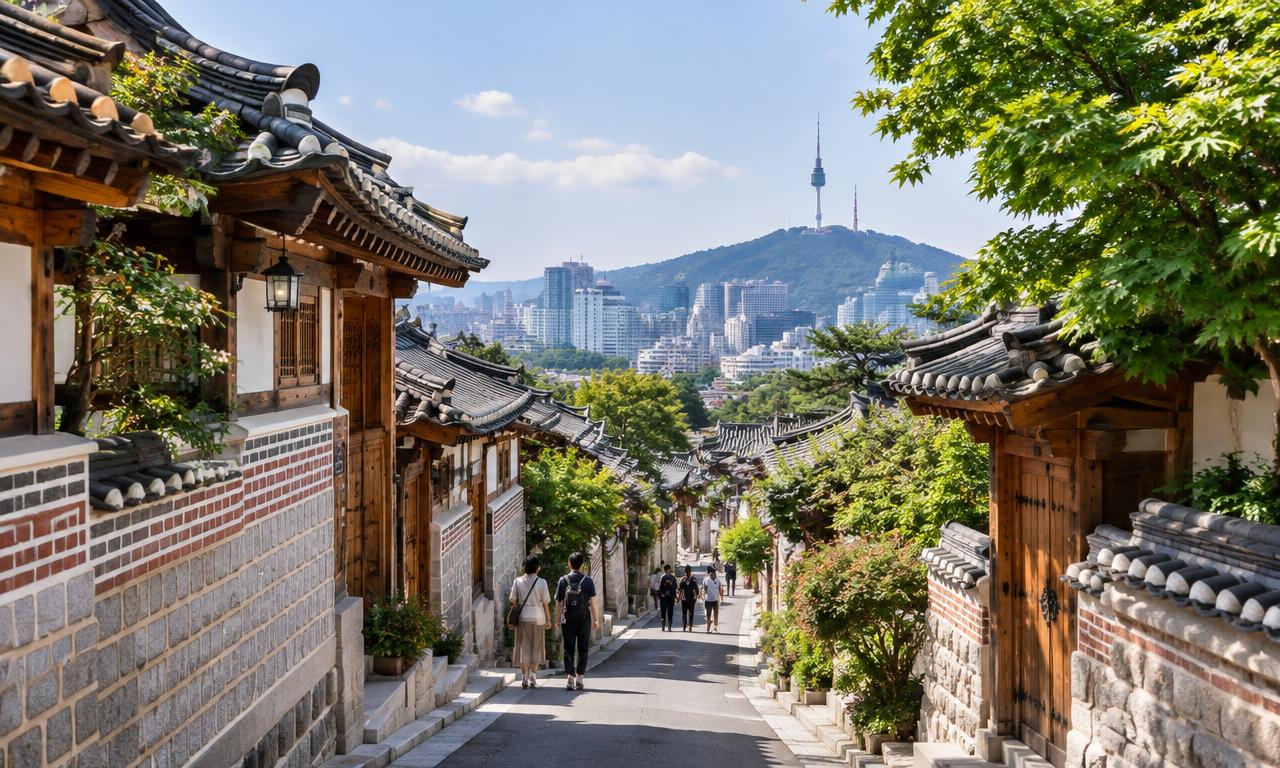
Seoul hanok streetscape · existing Settle Seoul editorial imagery, not a photograph of any featured accommodation.
Reviewed October 2026 · New online guide. General planning guidance; source types and verification limits are stated below. Not included in the original 2027 print edition; included in the complete Digital Guidebook.
- A hanok stay is accommodation, not a guarantee of a whole house, a Western bed or a private bathroom.
- Prices below are broad planning estimates, not quotes. Confirm the actual property, dates and total in writing.
- Residential lanes are home to neighbours. In Bukchon's designated Red Zone, sightseeing restrictions also matter.
A different rhythm, still in Seoul
A hanok (한옥, hanok) is a traditional Korean house, associated with timber framing, tiled roofs and a close relationship between rooms and outdoor space. Staying overnight gives you time to notice the courtyard light, the grain of the wood and the quiet between busy city outings. Some stays preserve a simple domestic feel; others are extensively renovated. The label alone does not tell you how comfortable, accessible or private a particular room will be.
Warm floors, different sleeping
- Ondol (온돌, ondol) means underfloor heating; a modern system may replace the traditional heat source. Ask how guests control it.
- Floor bedding may include a yo (요, yo), a padded sleeping mattress, and a duvet. Some properties instead offer Western beds. If getting down to the floor is difficult, confirm the actual bed before paying.
Stay, rather than rush
- Choose one nearby market, gallery or palace outing and leave time for the house itself.
- A hanok can be a memorable short break for visitors or Seoul residents, but suitability and eligibility depend on the accommodation's registration and house rules.
Choose the area before the room
These are general neighbourhood planning notes, not a ranking of accommodation quality. Check the exact address and door-to-door route: a district name can hide a steep final walk or an extra bus connection.
Bukchon · palaces and heritage
- Suits first-time visitors who want palace visits and traditional streets around their stay.
- The appeal: proximity to Gyeongbokgung and Changdeokgung, with heritage lanes and cultural stops nearby.
- The trade-offs: hills, steps, visitor crowds and sensitive residential streets. Parts of Bukchon have specific sightseeing restrictions; read the Red Zone guidance below.
Seochon · a slower city break
- Suits couples, gallery browsers and travellers who prefer a neighbourhood-led weekend west of Gyeongbokgung.
- The appeal: small galleries, cafés, local streets and Tongin Market as an easy anchor for exploring.
- The trade-offs: narrow lanes and mixed residential/commercial surroundings. A quiet-looking exterior does not guarantee soundproof rooms or step-free access.
Eunpyeong Hanok Village · nature nearby
- Suits families and nature-minded travellers who prioritise Bukhansan scenery and a visit to Jingwansa over central nightlife.
- The appeal: a village setting at Seoul's mountain edge, with space to make a slower itinerary.
- The trade-offs: farther from many central sights by public transport. Check the bus connection, last return options and each property's child policy; being in a family-friendly area does not mean every stay accepts children.
Ikseon-dong · cafés and evening energy
- Suits restaurant and café explorers who want the Jongno area close at hand.
- The appeal: compact lanes, food and lively evenings, with modern city connections nearby.
- The trade-offs: many hanok buildings here are cafés or restaurants, not accommodation. True overnight options are fewer; confirm the address, registration and whether nightlife noise reaches the room.
What might a night cost?
Indicative, non-binding planning bands in Korean won, per night—not live quoted rates, a market survey or offers from the example properties. Room size, whole-house use, occupancy, season, weekends and inclusions can change the total substantially. Lower and higher prices are possible.
Simple room · approx. KRW 70,000–150,000
- A starting planning range for simpler room-based accommodation. Do not assume a private bathroom, breakfast or a Western bed.
Boutique stay · approx. KRW 150,000–300,000
- A planning range for more design-led or upgraded stays; the word boutique does not establish any particular amenity.
Premium / private · approx. KRW 300,000–600,000+
- Private-house and premium stays can cost considerably more. Ask whether the displayed price is per room or for the entire property.
Confirm the final total for your dates and number of guests, including taxes, platform charges, extra bedding and any optional services. No availability, rate or discount is quoted here.
What to expect inside
A courtyard (마당, madang), timber details and paper-covered doors can be part of the pleasure. They also make this different from a standard hotel. Renovations vary widely, so inspect the current room description and ask direct questions.
Space, sound and privacy
- Hanji (한지, hanji) paper doors and timber partitions may transmit sound and light. A closed door is not a promise of hotel-style sound insulation.
- Courtyards may be shared. Confirm whether you book one room, a building or exclusive use of the whole house.
- Check bathroom location and whether it is private, shared or reached across an outdoor space.
Seasonal practicalities
- Wi-Fi, air conditioning, heating controls and modern bathrooms depend on the property; do not infer them from attractive photographs.
- Older buildings can have winter draughts even with warm floors. Ask about room heating and bathroom warmth.
- Summer brings humidity and insects, particularly around open courtyards. Ask about screens and air conditioning, and follow the host's door instructions.
- Thresholds, uneven floors and floor sleeping can be difficult with mobility needs. Request photographs and a precise access description, not simply 'easy access'.
Four stays to start your research
These are example properties, not affiliated recommendations, paid placements or verified offers. Official tourism and operator links are starting points; confirm the current property name, location, guest eligibility, amenities and terms directly. No vacancies or fixed rates are asserted.
Rakkojae Bukchon
- A hanok accommodation listed by Visit Seoul in Bukchon. A useful starting point for a heritage-focused central Seoul stay.
- Use the tourism listing to identify the property, then confirm the specific room and booking conditions with the operator.
Seochon Hanok Guesthouse
- The operator lists this traditional-house guesthouse at 28-3 Jahamun-ro 7-gil, Jongno-gu, with a traditional Korean housing experience business registration. Consider it when researching the Seochon side of Gyeongbokgung.
- Ask which room is being offered and whether sleeping, bathrooms and shared areas suit your party. The operator link identifies this property; do not confuse it with similarly named Seochon stays.
Eungjeongheon · Eunpyeong
- A hanok stay listed by Visit Seoul, relevant to an Eunpyeong Hanok Village itinerary.
- Confirm the address, transit route and guest policies before building a family or mountain-focused weekend around it.
The Chae · Seochon
- An operator with an official English reservation page. Check the named Seochon property rather than assuming every listing has the same layout or facilities.
- Read the individual stay's rules and cancellation terms, and confirm what is included in exclusive use, if offered. Automated access to the operator site was blocked during review; current booking details remain unconfirmed.
Book the actual stay, not just the photograph
Begin with registered accommodation and a clear written confirmation. A platform listing is not, by itself, proof that every traveller is eligible to stay under that property's registration. In particular, domestic residents should ask whether their booking can be accepted; some accommodation categories have guest restrictions. Let the host confirm your case rather than guessing from your nationality or a platform's checkout screen.
Seoul Stay
- The official Seoul accommodation directory is a useful place to identify stays and find their contact information. Check the listing's category and current operator details.
STAYFOLIO
- An English-language route for researching design-led accommodation. Confirm the individual stay's facilities, guest capacity and policies; availability belongs to the booking platform, not this guide.
Airbnb
- Many hanok homes appear on Airbnb. Message the host before booking to confirm the property is registered accommodation, whether your guest type can be accepted, and the sleeping, bathroom and heating arrangements.
- Read house rules and the cancellation policy for the exact listing; photos and reviews are not proof of current facilities.
Naver Booking / direct operator
- Local operators may use Naver Booking or their own reservation site. Korean-language messages, a local account or payment verification may be needed; ask about alternatives if you cannot complete the process.
- Obtain a confirmation showing the exact address, dates, guest count, amount paid and arrival contact. Read refund and cancellation terms before paying, including late arrival and no-show rules.
Your eight-point booking checklist
Tick each point once the host or listing has answered it for the exact room and dates you intend to book. Keep the answers with your confirmation; these ticks are only held during this page visit.
0 of 8 booking checks complete
A home, not a film set
The best hanok stay is considerate of the building, the host and the people next door. A beautiful residential lane is still somebody's everyday home.
Inside the house
- Remove shoes wherever the host asks; keep outdoor shoes off sleeping floors.
- Handle fragile paper doors and timber fittings gently. Ask before moving furniture or changing heating controls.
- Do not smoke or use candles, flames or fire equipment unless expressly permitted in a designated safe area. Follow all fire-safety instructions.
In the neighbourhood
- Keep conversations, luggage noise and courtyard gatherings quiet, especially at night. Follow the host's quiet hours.
- Do not photograph residents, peer through doors or enter private courtyards without permission.
- Ask where rubbish and recycling go; do not leave bags in the lane. Follow the property and district's sorting instructions.
The Red Zone is not an all-night sightseeing pass
Seoul's published notice sets restricted tourist sightseeing hours of 10:00–17:00 in the designated Bukchon Special Management Area Red Zone. This is not a ban across all of Bukchon. The notice provides for a KRW 100,000 (₩100,000) fine for breaches of the sightseeing restriction; enforcement began in March 2025. Guest-access guidance is also informed by Jongno-gu's local rules and exceptions (linked in the sources); follow the current signs and local instructions.
If you are staying there
- Properly booked accommodation guests have a limited exception to reach their lodging. Keep your reservation confirmation and ask the host which route and identification or proof are needed.
- That access exception is not blanket permission for unrestricted nighttime sightseeing, photography walks or visits to other residential lanes.
Before arrival
- Ask whether the property is within the designated Red Zone and how check-in, late arrival and departure should be handled.
- Use the city's notice, current on-street signs and host/local guidance. This is practical planning guidance, not a legal determination about your individual journey.
Sightseeing in the designated restricted area: 10:00–17:00. Lodging access: follow the limited guest exception and your host's instructions, not a general nighttime sightseeing assumption.
Beyond Seoul, when you have more time
If a night in Seoul makes you curious, consider a separate heritage-focused trip. These are onward-trip ideas, not accommodation recommendations or promises of stays inside protected villages.
Build a slower itinerary
- Jeonju Hanok Village for a larger hanok-focused city break.
- Gyeongju's Gyochon area alongside a wider historic-city visit.
- Andong Hahoe for a living heritage-village experience; verify visitor rules and lodging locations.
- Jeollanam-do for a broader regional itinerary with traditional villages and individual hanok stays—check distances before booking.
For a first Seoul weekend, choose one neighbourhood, confirm the eight booking essentials and leave breathing room in your itinerary.
Editorial guide based on official sources, reviewed October 2026. Confirm current requirements with the responsible office before acting.