
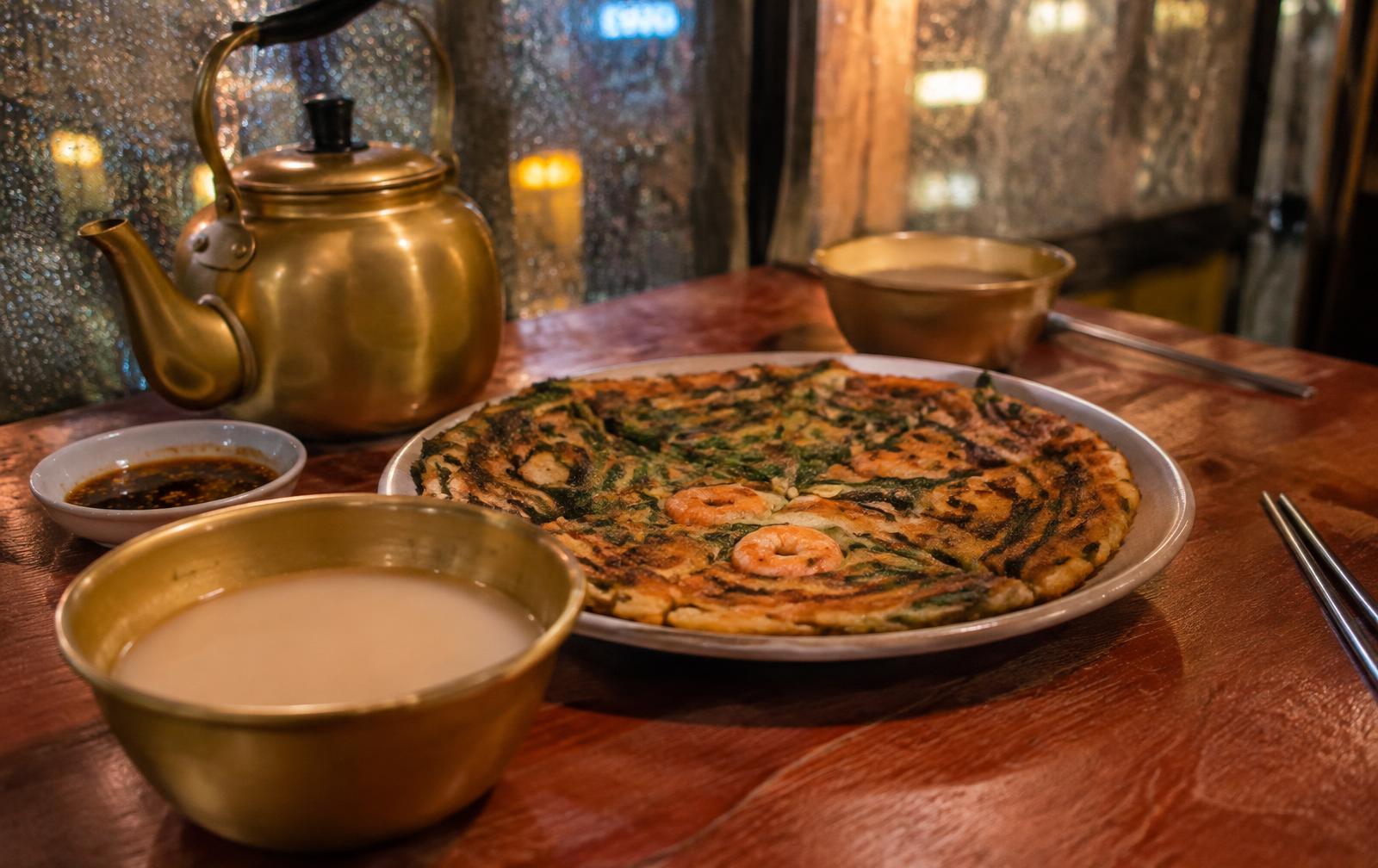
Makgeolli in Seoul: A Newcomer’s Guide to Korea’s Oldest Drink.
From convenience-store green bottles to naturally sparkling craft brews: how fresh rice wine is bought, opened, paired and shared.
Reviewed November 2026 · New online guide. General planning guidance; source types and verification limits are stated below. Not included in the original 2027 print edition; available as a separate article PDF; not included in the 18 October 2026 Digital Guidebook.
- Fresh (생) makgeolli is alive: keep it cold and upright, and open it slowly.
- Read the label for 생 (fresh) or 살균 (pasteurised) before you buy.
- Drink with food, pace yourself, and never drive afterwards.
Why fresh makgeolli rarely leaves the country
Makgeolli (막걸리) is a lightly filtered fermented drink made from rice or wheat, water and nuruk (누룩), a traditional fermentation starter. Visit Korea describes it as usually around 4–6% ABV, recorded in historic texts under its older name takju (탁주), and still made in more than a thousand varieties. The name is often explained as ‘roughly’ or ‘freshly’ filtered.
Fresh · 생막걸리 (saeng-makgeolli)
- Unpasteurised, with live yeast still working in the bottle. It keeps producing gentle fizz and slowly becomes drier and more sour.
- Short shelf life and needs refrigeration, which is why it is so hard to find in good condition abroad.
Pasteurised · 살균 막걸리 (salgyun)
- Heat-treated so fermentation stops. Shelf-stable, milder and more consistent.
- This is what most export bottles are, so the taste back home is often different from a cold fresh bottle in Seoul.
Visit Korea explains that filtering makgeolli gives cheongju (청주, refined rice wine), and distilling cheongju gives soju. Makgeolli is the base of much of Korea’s traditional drinks culture.
Buying a bottle at CU, GS25 or the mart
The chilled aisle of any convenience store usually has a few everyday makgeolli bottles; marts and department-store food halls carry regional and premium ones. A few words on the label tell you most of what you need.
생 / 生 · fresh
- Look for 생막걸리 on the front. Keep it upright and in the fridge on the way home.
살균 · pasteurised
- Fine for gifts, picnics or travel, since it does not need constant chilling until opened (check the label).
Ingredients · 원재료명
- 쌀 (ssal) is rice; 국내산 means domestic; 밀 (mil) is wheat. Some everyday bottles add sweeteners such as 아스파탐 (aspartame); many premium brews use only rice, nuruk and water.
Dates · 소비기한 / 제조일자
- 소비기한 is the use-by date; 제조일자 is the production date. A young fresh bottle tends to taste sweeter; an older one drier and tangier.
Strength · 알코올 도수
- Shown as a percentage. Everyday bottles are commonly around 6%; some premium undiluted styles are much stronger, so check before you pour.
How to open it without a fountain
Fresh makgeolli separates into a clear top layer and a milky sediment. Mixing it is part of the fun, but fresh bottles are carbonated and can erupt if shaken hard.
- 011 · Keep it cold
Cold makgeolli holds its fizz better. Open it straight from the fridge.
- 022 · Turn, don’t shake
Slowly tip the bottle upside down and back a few times, or roll it gently, until the sediment lifts.
- 033 · Crack and release
Twist the cap just enough to hiss, close it again, wait a moment, then repeat until the pressure has eased.
- 044 · Pour into a bowl
Many pubs serve it in a kettle (주전자, jujeonja) with shallow bowls (사발, sabal). Pouring for others first is a friendly gesture.
Naturally sparkling makgeolli can take a few minutes of releasing pressure. Follow the brewer’s instructions on the label and open it over a sink.
Jeon and makgeolli
When rain starts, many people in Seoul think of savoury pancakes (전, jeon) with makgeolli. A common explanation is that the patter of rain sounds like batter sizzling in oil. Whatever the reason, the bright acidity of cold makgeolli suits crisp, oily food very well.
Pajeon · 파전
- Spring onion pancake, often with seafood as haemul pajeon (해물파전).
Bindaetteok · 빈대떡
- Mung bean pancake, closely associated with market stalls.
Gamja-jeon · 감자전
- Crisp potato pancake. Visit Korea suggests haemul pajeon and gamja-jeon as makgeolli pairings in Insa-dong.
Dubu-kimchi · 두부김치
- Warm tofu with stir-fried kimchi, an easy shared plate if you want something lighter.
Styles to look for
There is no single ‘correct’ makgeolli. Use these broad styles to describe what you liked, then ask staff or a shop for something similar. Brands and recipes change, so treat these as style notes, not rankings.
Everyday · 대중 막걸리
- The green and white bottles in convenience stores. Light, often a little sweet, inexpensive, and the easiest place to start.
Sparkling · 스파클링 막걸리
- Naturally carbonated in the bottle, sometimes compared to sparkling wine. Usually pricier and needs careful opening.
Undiluted / strong · 원주
- Less water added after fermentation, so thicker and stronger. Small pours and plenty of food.
Flavoured · 밤 · 옥수수 · 꿀
- Chestnut (밤, bam), corn (옥수수, oksusu) and honey (꿀, kkul) versions are common and often sweeter.
Regional · 지역 막걸리
- Visit Korea notes that almost every region has at least one representative brewery. Trying the local bottle is a good habit on day trips.
Learn, then drink
Start somewhere that explains what you are tasting, then try a traditional pub. Opening times and programmes change, so check the official pages linked in Sources before you go.
The Sool Gallery · 전통주갤러리
- 18 Bukchon-ro, Jongno-gu (서울 종로구 북촌로 18), about a two-minute walk from Anguk Station (Line 3) exit 2, per Visit Seoul.
- An exhibition and tasting space for traditional Korean drinks. Visit Korea lists free entry, 10:00–19:00, closed Mondays and major holidays, and English tastings at 15:00 except Mondays.
Insa-dong · 인사동
- Visit Korea describes Insa-dong as lined with traditional bars and features a pub there offering dozens of makgeolli with jeon pairings.
Brewery visits · 찾아가는 양조장
- The government-backed brewery visit programme, listed on thesool.com, offers tastings and experiences around the country — a good weekend trip.
Phrases and etiquette
A few words go a long way. Romanisation is a guide; showing the Hangul on your phone also works.
생막걸리 한 병 주세요
- saeng-makgeolli han byeong juseyo — One bottle of fresh makgeolli, please.
주전자로 주세요
- jujeonja-ro juseyo — In a kettle, please.
덜 단 거 있어요?
- deol dan geo isseoyo? — Do you have something less sweet?
건배!
- geonbae! — Cheers!
- 01Two hands for elders
When someone older pours for you, hold your bowl with both hands (or one hand supporting the other).
- 02Pour for others
It is customary to fill other people’s cups rather than your own.
- 03Saying no is fine
Leave your bowl partly full or simply say 괜찮아요 (gwaenchanayo, I’m fine). Nobody needs a reason.
Korea’s legal drinking age is set by birth year (generally those turning 19 that year), and staff may check ID. Makgeolli can feel lighter than it is: alternate with water, eat, and never drive or ride a scooter after drinking.
Editorial guide based on official sources, reviewed November 2026. Confirm current requirements with the responsible office before acting.