Korea's International Student Boom: What Happens After Graduation?.
Korea has passed 300,000 international students ahead of its target. The next challenge is making sure studying here can lead to meaningful opportunities afterwards.
Reviewed 22 October 2026 · New online guide. General planning guidance; source types and verification limits are stated below. Not included in the original 2027 print edition; included in the complete Digital Guidebook.
- South Korea-wide enrolment figures, not Seoul alone.
- Survey findings and graduate outcomes describe different groups.
- A longer potential D-10 stay is not an unrestricted right to work.
Korea has reached the number. What comes next?
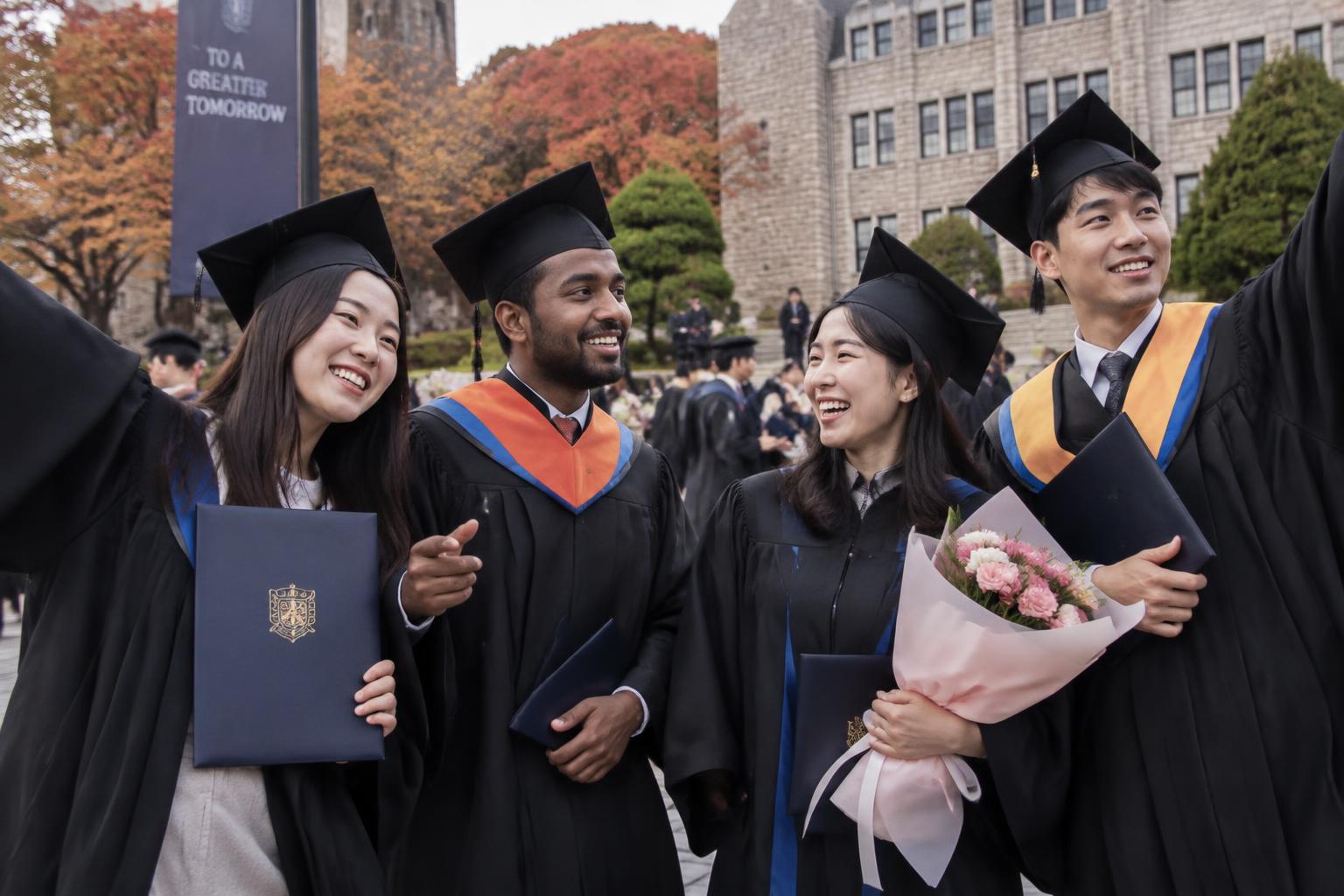
More than 300,000 international students are now enrolled in South Korea. For a country that set out to reach that number by 2027, surpassing the target in 2026 is a significant milestone. It also raises a more personal question for the students arriving in Seoul, Busan, Daejeon and university towns across the country: what happens once their studies are finished?
According to reporting published by The Korea Times on 22 October 2026, international enrolment reached 307,464 in 2026. In one graduate cohort, covering 36,271 international students who finished between August 2023 and February 2024, 42.9% left Korea and fewer than 5,000 found work in the country. These figures describe different periods, and they do not mean that everyone who remained was employed. But they illustrate a gap between welcoming students into higher education and helping graduates move into the next stage of life. [1]
For students, graduation is often presented as the finish line. In practice, it can be the point at which the difficult questions begin: Does my current residence status still cover me? Can I take an internship? Which jobs could qualify for a work visa? Will an employer help with the paperwork? How long can I stay while searching?
Interest in staying is not the same as a clear route
The Korea Times cites a 2025 Korea Federation of SMEs survey in which 86.5% of surveyed international students said they wanted to work in Korea after graduation. That is a finding from a particular survey, not a measurement of every international student in Korea. Even with that qualification, it suggests that many students are not thinking of Korea as a temporary study destination alone. [1]
Their reasons will differ. Some want experience in technology, research, design or business. Some have developed professional networks, a relationship or a life in Korea. Others hope to develop their Korean-language skills through work before deciding where to settle. There is no single ideal outcome: returning home, moving to another country and remaining in Korea can all be sensible choices.
The important point is that students should be able to make those choices with clear information rather than discover the rules when their status is close to expiring.
The transition is practical as well as academic
A degree does not by itself create permission to work in any job. Korea's immigration system distinguishes between studying, job-seeking and employment. A student who finds an employer may need to change to an appropriate work-related status; another graduate may qualify for D-10 job-seeking status while looking for professional employment. Each route has conditions. [3][4]
Meanwhile, day-to-day arrangements do not stop mattering after the final exam. A graduate may be moving out of university housing, keeping a Korean phone contract active, arranging health-insurance coverage or needing a usable bank account before the first salary arrives. A job offer is more than a headline amount: job duties, employer identity, pay, hours, contract terms and the proposed immigration route all deserve scrutiny.
These are ordinary practical questions, but when several arrive at once they can make the transition unusually stressful.
Policy is beginning to address the gap
In September 2026, the Ministry of Education set out a change of emphasis for international-student policy. Alongside recruitment, it highlighted education quality, stronger support through study and career planning, and closer connections between institutions and employers. Some university-focused measures are proposals or future initiatives rather than services every student can use immediately. [2]
There has also been a concrete change to the job-seeking route. In a December 2025 announcement, the Ministry of Justice described improved D-10 conditions for eligible graduates from Korean universities, including a maximum job-seeking period of three years rather than two, with possible extensions in one-year periods. It also announced more flexible internship-duration rules for the relevant group. Eligibility and permission must still be checked individually, and older online summaries have not all been updated. [3][4]
The distinction matters. A longer potential period to look for work is helpful, but it is not an automatic three-year visa, an unrestricted right to work or a promise of sponsorship from an employer.
Five things students can do before the final semester
Start with your immigration timeline. Check the date on your residence record and ask your university's international office which routes may fit your course, expected graduation date and plans. Do this before the final weeks of the semester. A booked appointment and an approved change of status are not the same thing.
Understand the jobs available to you. Look at actual vacancies and the qualifications required, not only sector descriptions. A bachelor's or master's degree may be relevant to several professional categories, but an employer and position still have to meet the correct immigration rules. [4]
Build evidence of your work. Keep a concise CV, descriptions of internships and projects, a portfolio where relevant, transcripts, language certificates and references. Employers should be able to understand what you can contribute without guessing from your degree title alone.
Use the people already around you. Career centres, international offices, professors, alumni and student associations can help connect academic experience with potential employers. The government's Study in Korea employment resources also point students towards recruitment platforms and career services. [5]
Prepare for everyday continuity. Keep copies of your lease or accommodation confirmation, an accessible phone number, bank details, current identity documents and copies of immigration correspondence. A change of address has its own reporting obligations; it should not be lost in the move from campus to work. [4]
A graduation should open choices, not confusion
International study is more than an enrolment figure. It is an investment of time, money and ambition, often made far from family and in another language. Students deserve to know what their options really are when that investment reaches graduation.
For anyone hoping to remain in Korea, the practical advice is simple: start early, verify your individual eligibility with immigration and your university, and treat the employment contract and residence status as connected decisions. For universities and employers, the challenge is to make those paths clearer well before graduation day.
Read next: After Graduation in Korea · Student Jobs · Other English-speaking Jobs
Editorial note: The total 307,464 applies to South Korea, not Seoul alone. The 42.9% departure figure applies to the specific 2023–24 graduate cohort identified by The Korea Times. This feature is original commentary informed by cited reporting, not a reproduction of the newspaper article.
Source notes for Article A: [1] Korea Times; [2] Ministry of Education 8 and 21 September 2026; [3] Ministry of Justice 2 December 2025; [4] Study in Korea employment/immigration guidance; [5] Study in Korea employment resources. Full URLs appear in Sources & verification below.
Editorial guide based on official sources, reviewed 22 October 2026. Confirm current requirements with the responsible office before acting.